How to Get a Personal Loan in India
A Personal Loan is one of the fastest and most convenient financial solutions available in India. Whether you need funds for a medical emergency, wedding, education, travel, home renovation, debt consolidation, or any personal expense, a personal loan provides instant financial support without requiring any collateral.
With the rise of digital banking and fintech services, getting a personal loan has become easier than ever. Most lenders now offer 100% online applications, quick approvals, minimal documentation, and fast disbursal.
In this comprehensive guide, you’ll learn how to get a personal loan in India, eligibility criteria, required documents, application process, tips to improve approval chances, and answers to frequently asked questions.
What is a Personal Loan?
A Personal Loan is an unsecured loan offered by banks and NBFCs to individuals for personal financial needs. Since it is unsecured, you do not need to pledge any property, gold, or other assets as security.
The loan amount can usually range from ₹50,000 to ₹50 Lakhs, depending on your income, credit score, employment type, and repayment capacity.
Common Uses of Personal Loan
- Medical Emergency
- Wedding Expenses
- Higher Education
- Home Renovation
- Vacation & Travel
- Debt Consolidation
- Business Requirement
- Festival Expenses
- Consumer Durable Purchase
- Emergency Cash Requirement
Benefits of Taking a Personal Loan
1. No Collateral Required
Personal loans are unsecured loans, so you don’t need to mortgage your house, property, or gold.
2. Quick Approval
Many lenders approve eligible applications within a few hours.
3. Instant Disbursal
After approval, funds can be credited within 24–48 hours.
4. Flexible Repayment
Choose repayment tenures from 12 months to 84 months.
5. Minimal Documentation
Most lenders require only basic KYC, income proof, and bank statements.
6. Multiple Usage
You can use the loan amount for almost any legal personal purpose.
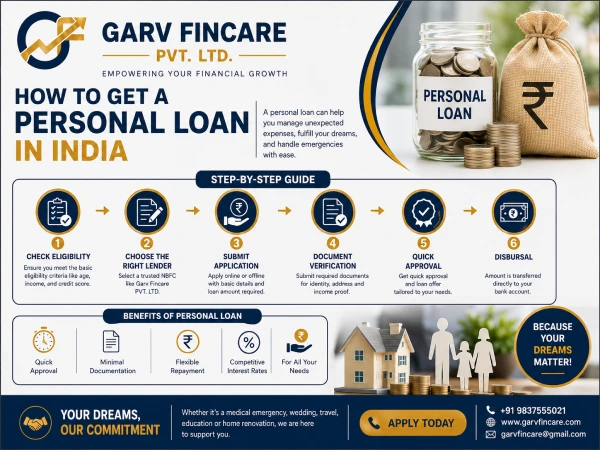
How to Get a Personal Loan in India (Step-by-Step Guide)
Step 1: Check Your Eligibility
Before applying, verify whether you meet the lender’s eligibility criteria.
Generally, lenders check:
- Age
- Monthly Income
- Employment Status
- Credit Score
- Existing Loan Obligations
- Residential Stability
- Work Experience
Step 2: Check Your Credit Score
Your CIBIL Score plays a major role in loan approval.
Ideal Credit Score
- 750+ – Excellent
- 700–749 – Good
- 650–699 – Average
- Below 650 – Lower approval chances
A higher score helps you get:
- Lower Interest Rates
- Higher Loan Amount
- Faster Approval
- Better Loan Offers
Step 3: Calculate Your Loan Requirement
Borrow only the amount you actually need.
Before applying, calculate:
- EMI affordability
- Monthly expenses
- Existing EMIs
- Future repayment capacity
Avoid borrowing more than necessary to reduce your interest burden.
Step 4: Compare Personal Loan Offers
Never apply to the first lender you find.
Compare:
- Interest Rate
- Processing Fee
- Prepayment Charges
- Foreclosure Charges
- Loan Tenure
- EMI
- Customer Reviews
- Hidden Charges
Comparing lenders can save thousands of rupees over the loan tenure.
Step 5: Gather Required Documents
Generally, lenders ask for:
Identity Proof
- Aadhaar Card
- PAN Card
- Passport
- Driving License
Address Proof
- Aadhaar
- Utility Bill
- Passport
- Voter ID
Income Proof
For Salaried Employees:
- Salary Slips
- Bank Statements
- Form 16
For Self-Employed:
- Income Tax Returns
- GST Returns
- Business Proof
- Bank Statements
Step 6: Submit the Loan Application
Apply either:
- Online
- Offline
- Through a Loan Consultant
Fill in:
- Personal Details
- Employment Details
- Income Details
- Loan Amount
- Loan Purpose
Upload all required documents carefully.
Step 7: Verification Process
The lender verifies:
- Identity
- Employment
- Income
- Credit History
- Address
- Bank Statements
Some lenders may conduct a verification call.
Step 8: Loan Approval
Once verification is complete, the lender sends:
- Loan Approval Letter
- Loan Agreement
- EMI Details
- Interest Rate
- Repayment Schedule
Read all terms before accepting.
Step 9: Loan Disbursal
After signing the agreement, the approved amount is transferred directly to your bank account.
Depending on the lender, disbursal may happen within:
- Same Day
- 24 Hours
- 48 Hours
Personal Loan Eligibility in India
Most lenders require applicants to meet the following conditions:
Age
- 21–60 years
Employment
- Salaried Employee
- Self-Employed Professional
- Business Owner
Monthly Income
Generally starts from ₹15,000–₹25,000 depending on the lender.
Work Experience
- Minimum 6–12 months with the current employer
- Stable employment history
Documents Required for Personal Loan
Identity Proof
- PAN Card
- Aadhaar Card
Address Proof
- Passport
- Driving License
- Utility Bill
Income Proof
- Salary Slips
- Bank Statements
- Form 16
- Income Tax Returns
Photograph
Recent passport-size photograph.
Factors Affecting Personal Loan Approval
Several factors influence whether your loan gets approved:
- Credit Score
- Monthly Income
- Existing EMIs
- Employment Stability
- Age
- Debt-to-Income Ratio
- Banking Relationship
- Repayment History
Tips to Increase Personal Loan Approval Chances
✔ Maintain a CIBIL score above 750
✔ Pay all EMIs on time
✔ Avoid multiple loan applications
✔ Keep existing debt low
✔ Maintain stable employment
✔ Submit accurate documents
✔ Choose an affordable EMI
✔ Apply with a reputed lender
Common Reasons for Personal Loan Rejection
- Low Credit Score
- Insufficient Income
- High Existing Debt
- Incomplete Documents
- Incorrect Information
- Frequent Job Changes
- Multiple Recent Loan Applications
- Poor Repayment History
How to Get a Personal Loan with a Low Credit Score
If your credit score is low:
- Improve your repayment history.
- Clear outstanding dues.
- Reduce credit card utilization.
- Apply with a co-applicant, if possible.
- Choose a smaller loan amount.
- Build a better credit profile before reapplying.
Personal Loan Interest Rates in India
Interest rates vary depending on:
- Credit Score
- Income
- Employer Profile
- Loan Amount
- Repayment Tenure
- Lender Policies
Applicants with stronger financial profiles generally receive more competitive rates.
Personal Loan EMI Calculation
Your EMI depends on:
- Loan Amount
- Interest Rate
- Loan Tenure
Using an EMI calculator before applying helps you understand your monthly repayment commitment and choose a suitable tenure.
Mistakes to Avoid While Applying
- Applying to multiple lenders at the same time
- Borrowing more than required
- Ignoring hidden charges
- Missing EMI payments
- Providing incorrect information
- Not reading the loan agreement
- Choosing a very short repayment tenure without affordability
Why Choose Garv Fincare for Your Personal Loan?
At Garv Fincare, we simplify the personal loan process by helping you compare suitable loan options from trusted lending partners. Our focus is on quick assistance, transparent guidance, and end-to-end support throughout the application journey.
Why Customers Choose Garv Fincare
- Quick Loan Assistance
- Simple Documentation
- Fast Processing Support
- Competitive Loan Options
- Dedicated Customer Guidance
- Transparent Process
- Assistance for Salaried & Self-Employed Applicants
- Support Across Multiple Loan Requirements
Conclusion
Getting a personal loan in India has become simpler than ever. By maintaining a healthy credit score, preparing the necessary documents, comparing lenders, and understanding the loan terms, you can improve your chances of approval and secure funds quickly for your financial needs.
Whether you’re planning a wedding, managing medical expenses, renovating your home, or consolidating debt, a well-chosen personal loan can provide timely financial support. Always borrow responsibly, evaluate your repayment capacity, and choose a trusted financial partner for a smooth borrowing experience.